
Camino Packing List: What to Pack for the Camino de Santiago
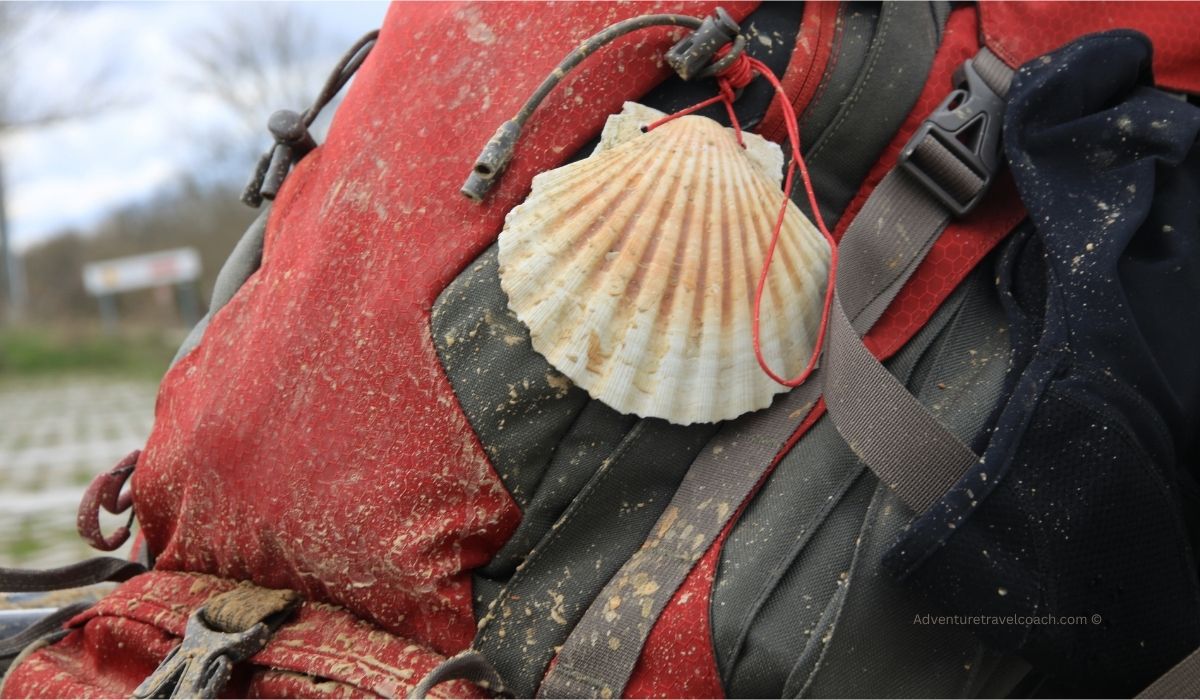
Think you need to pack everything you’ve been told to take on the Camino? Think again! 🥾
Before walking the Camino, I did plenty of homework and read countless tips and recommendations from other pilgrims. But after actually walking the Camino Francés, I quickly realised that not everything you read in Camino groups applies to you! My Camino packing list ended up including a few things I simply didn’t need, and I learned that some advice is best taken with a pinch of salt. What works brilliantly for one pilgrim may be completely unnecessary for another. So, based on my own experience, here’s my Packing List for the Camino de Santiago, and this is what I actually used, what I wish I had left at home, and what I would pack differently next time.
Ultimate Camino de Santiago Packing List: What You Really Need
Think you need to pack everything you’ve been told to take on the Camino? Think again! 🥾
Before You Start Packing for the Camino ask yourself what would I really need and cannot do without? Before walking the Camino Francés, I did plenty of homework and read countless tips from other pilgrims. But once I started walking, I quickly realised that not everything you read in Camino groups applies to you!
My Camino packing list included a few things I simply didn’t need. I learned that what works brilliantly for one pilgrim may be completely unnecessary for another. Based on my own experience, here is my packing list for the Camino de Santiago, including what I used, what I wish I had left at home, and what I would pack differently next time.
Before You Start Packing for the Camino
Remember one important thing: if you carry your belongings yourself, you have to carry every gram! Walking 15–20 km a day with an unnecessarily heavy backpack can quickly take the fun out of your Camino. My advice? Pack light, pack practical and think carefully about what you really need. You can wash clothes along the way, and you can buy many essentials if necessary.
Backpack and Camino Gear
Before choosing your backpack, decide whether you will carry everything yourself or use a luggage transfer service and walk with only a daypack.
Full-Size Backpack vs Daypack
The best backpack for the Camino de Santiago is depending if you want to carry everything yourself, or use luggage transfer. A 30–40 litre backpack is generally suitable if you plan to carry everything yourself. Aim to keep your loaded backpack to around 10% of your body weight, if possible. When it comes to a daypack, the best daypack for travelling and walking the Camino is a comfortable lightweight backpack weighing not more than 25 litres. If you use luggage transfers, a small, lightweight daypack is usually sufficient for your daily essentials.
On all Camino routes, one must always be prepared for unexpected events like rain. A day can start with clear blue skies but change quickly. When that happens, you’ll want to protect not only yourself but also your gear. So you don’t just need a rain jacket; you also need a rain cover for your backpack.
Rain Jacket vs Poncho
I prefer a lightweight rain jacket and backpack rain cover rather than a poncho.
- Rain jacket: Comfortable to walk in and useful in changeable weather.
- Poncho: Covers both you and your backpack, but can flap around in windy conditions.
- Small umbrella: Optional, but I wouldn’t walk the Camino without a small lightweight umbrella.
Footwear for the Camino
Shoes are the most important item on your Camino journey. The best shoes for the Camino de Santiago are lightweight, breathable, well-cushioned, and able to handle mixed terrain, hard concrete/asphalt, dirt roads, and gravel. Over long distances, feet naturally expand and swell, so shoes that worked for you on a 5-day trial may not be perfect for a long Camino trial; trust me on this.
The right shoes for your Camino depend on your feet, as everyone is different. Walking long distances over mixed terrain makes comfort, fit, cushioning and grip especially important. Choose well-fitting walking shoes that suit the shape of your feet.
Trail Runners vs. Hiking Boots
- Trail Running Shoes (Top Pick): Most experienced pilgrims prefer low-cut trail runners (such as models from Hoka, Altra, or Speedgoat wide). They are lightweight, reduce leg and pack strain, offer great traction on mixed terrain (cobblestones, dirt, asphalt, mud), and dry out quickly. Avoid flat gym sneakers, as they offer no protection against sharp stones.
- Mid-Cut Hiking Boots: Reserved mainly for those with pre-existing ankle instability, a history of rolling ankles, or if you are walking through cold, snowy, or very muddy winter/shoulder seasons. They are heavier, trap more heat, and take much longer to dry if soaked.
- Waterproof shoes are not the best option because their protective membranes trap sweat and heat, leading to damp feet causing blisters. A Non-waterproof shoe gets soaked but typically dries overnight;
- Size Up (Half to Full Size Larger): A standard fit shoe can cause hot spots, and cramped toes, causing blisters. Your feet will swell significantly over walking long distances day after day. Buying a half-size or full-size larger than your normal streetwear size prevents your toes from jamming into the front of the shoe on steep descents.
- Wide Toe Box: Avoid narrow or pointed toe boxes, which can squeeze your toes, and opt for a roomy toe box to accommodate natural foot movement and swelling. Look for brands that allow your toes to splay naturally such as Altra, Speedgoat wide, or Topo Athletic.
- Cushioning: While Altra Lone Peaks, which require your muscles to absorb the impact, the massive Hoka foam stack does the heavy lifting for your knee joints.
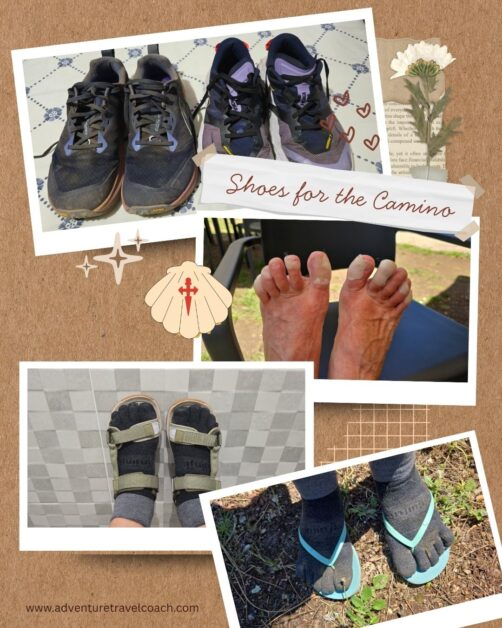
My experience: I walked the Portuguese Camino in Hiking boots that never gave me blisters on 5-day trails, but the Camino was a completely different story. Walking the Camino Francés in trail shoes with a wider toe box was a much better option.
Direct Comparison between three popular shoes
| Feature | Altra Lone Peak 9 | Hoka Speedgoat 7 | Topo Athletic Ultraventure 5 |
|---|---|---|---|
| Cushioning Type | Minimal / Natural | Maximum / Plush | Balanced / Soft-Max |
| Stack Height | 25 mm | 40 mm heel / 35 mm forefoot | 35 mm heel / 30 mm forefoot |
| Heel-to-Toe Drop | 0 mm (Zero Drop) | 5 mm | 5 mm |
| Toe Box Width | Ultra-wide (FootShape) | Narrow / Pointed (Wide variant available) | Wide & Anatomical |
| Midfoot / Heel Lock | Loose / Relaxed | Snug / Locked-in | Snug / Locked-in |
| Rock Protection | Built-in StoneGuard plate | Thick foam absorbs impact (No plate) | Thick foam absorbs impact (No plate) |
| Outsole Rubber | MaxTrac (Vibram Megagrip on “9+” model) | Vibram® Megagrip | Vibram® Megagrip |
Altra Lone Peak 9
The Lone Peak 9 is the purist’s trail shoe. It keeps your heel and forefoot at the exact same height from the ground (zero-drop).
- The Good: It has the most expansive, foot-shaped toe box on the market, giving your toes complete freedom to splay out. It is excellent if you hate cramped feet or are prone to friction blisters between your toes. It also features an integrated rock plate to shield you from sharp stones.
- The Catch: With a modest 25mm stack height and firm Altra EGO foam, it offers minimal shock absorption. On long, hard stretches of asphalt or concrete on the Camino, your feet will feel the impact. Furthermore, if you are not already fully transitioned to zero-drop shoes, walking 25+ km a day in these can cause severe calf and Achilles tendon fatigue.
Hoka Speedgoat 7
The Speedgoat 7 sits in the max-cushioning category, using a highly bouncy, reworked supercritical foam to absorb heavy trail impacts.
- The Good: Supreme underfoot protection. The 40mm stack height and aggressive, rockered sole create a rolling stride that effortlessly propels you forward, drastically reducing joint and foot fatigue on hard surfaces.
- The Catch: Hoka is notoriously narrow. Even in the “Wide” variant, the toe box remains tapered and pointed.
Topo Athletic Ultraventure 5
The Ultraventure 5 is an ideal middle ground for many Pilgrims, blending the best of Altra and Hoka.
- The Good: Topo mimics Altra’s wide, anatomical, foot-shaped toe box to prevent swelling blisters, but pairs it with a secure, locked-in heel and midfoot fit so your foot doesn’t slide around. With a plush 35mm stack height and an upgraded, softer ZipFoam midsole that protects your feet from road vibration.
- The Catch: The conservative 5mm drop and lightweight design, it lacks the radical, aggressive “rocking” sensation some hikers prefer for uphill momentum.
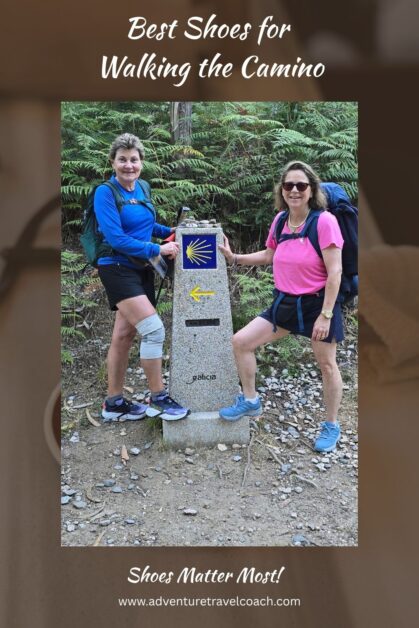
The Recommendation
- Choose the Topo Ultraventure 5 if you want the ultimate all-rounder for the Camino. It gives your toes the room to breathe while shielding your joints with ample cushioning and avoiding the calf strain of a zero-drop shoe.
- Choose the Hoka Speedgoat 7 if underfoot plushness is your absolute highest priority, you prefer a rockered stride, and your feet are on the narrower side (or you comfortably fit into Hoka’s wide sizes.
- Choose the Altra Lone Peak 9 if you are already fully adapted to zero-drop footwear, want maximum ground feel, and plan to walk mostly on softer, natural dirt paths rather than paved roads.
Shoes that should be on Your Packing List
- Broken-in walking shoes or trail shoes.
- Outdoor sandals or another pair of trail shoes.
- Lightweight sandals or flip-flops.
Are Walking Poles Necessary?
Yes! I recommend walking poles for all Caminos, especially the Camino Francés and the Camino del Norte. They help with balance and stability and can reduce strain on your knees and joints, particularly on steep climbs and descents. If you’re a fast walker like me, poles also encourage a shorter stride, which can help reduce pressure on your forefoot and toes.
Best Footcare and Socks for Camino de Santiago
Besides the right shoes, footcare are the another important thing as blisters can quickly turn an enjoyable walk into a painful experience. Callus is a thickened, hardened area of skin that forms as a protective response to repeated friction, rubbing, or pressure.
Methods to Prevent Calluses
Your soles of the feet, heels, balls of the feet, and toes needs to be treated to prevent callus. It is important that any hard skin should be failed off.
- Preparation: Endure that sll hard skin on you toes, and heels are failed off.
- The Compeed Anti Blister Stick is a preventative anti-friction balm rather than a medical necessity.
- Protective Padding: Use non-medicated or moleskin pads, gel sleeves, or adhesive pads around high-friction areas to cushion the skin and absorb rubbing.
- Supportive Orthotics: Use custom-molded orthotics or arch supports to redistribute body weight evenly and relieve focal pressure points.
- Socks: Cushioned socks designed to absorb impact and reduce friction. ,
- Skin Moisturization: Apply foot creams or lotions containing ingredients like urea, salicylic acid, or lactic acid to keep skin soft and pliable.
- Gentle Exfoliation: Use a damp pumice stone or foot file regularly to lightly slough off dead skin cells before they build into thick layers.
Although some hikersbelieve that to use Vasline on their feet to prevent blisters, it didnt work for me and this is why – Vaseline pure Petroleum Jelly 100% does not contain urea, salicylic acid, or lactic acide.
Electronics and Gadgets
- Mobile phone
- Phone charging cable
- Plug adapter
- Power bank
- Earphones
- 2 point plug & Chargers
Toiletries and Personal Care
- Toothbrush and toothpaste
- Shampoo, & body wash
- Deodorant
- Sunscreen & Lip balm
- Moisturiser
- Tissues or wet wipes
- Nail clippers
Documents, Money and Travel Essentials
- Passport
- Pilgrim passport (credential)
- Travel insurance details
- Flight tickets and accommodation bookings
- Bank cards and some euros
- Copies or photos of important documents
- Journal & Pen
- Ear plugs and mace mask
Essential Camino Gear
- Lightweight backpack or daypack
- Backpack rain cover, if carrying a backpack
- Walking poles
- Small umbrella
- Reusable water bottle
- Quick-dry travel towel
- Earplugs
- Sleeping bag liner, and small padlock
Camino de Santiago Packing List: Clothing and Essentials
You don’t need a different outfit for every day. Keep your clothing lightweight, comfortable and quick-drying.
My Lightweight Moonbag
I carry a lightweight moonbag around my waist to keep important items within easy reach while walking.
Mine contains my mobile phone, tissues, lip balm, credit card, cash, passport, Pilgrim passport, a note with my travel insurance details and the keys to my main backpack. I find this much more convenient than constantly opening my backpack to look for essentials.
What I Packed but Didn’t Need
Precations against Bed Bugs
I’d read so many stories about bed bugs that I became quite stressed about them! I spent money on sprays and other products to protect my backpack, clothing and bedding — but never needed any of it.
Mattresses and Bedding
I’d also read that some hostels only cover their mattresses with paper, but this was never my experience. Even in municipal hostels, the mattresses and cushions appeared to have clean covers.
Blow-Up Cushion
A complete waste of money and space. I never used it!
Ready to Plan Your Camino?
🚶♀️ Not sure which route to choose? Read my guide: Which Camino de Santiago Route Is Right for You?
🌄 Planning to walk the French Way? My Complete Guide to the Camino Francés covers the route and practical advice to help you prepare for your journey.
Before you start throwing everything into your backpack, remember one important thing: you have to carry it all! Walking 15–25 km a day with an unnecessarily heavy backpack can quickly take the fun out of your Camino. I did plenty of research before walking the Camino Francés and, despite all my preparation, I still packed things I simply didn’t need.
I also learned that advice from Facebook groups should be taken with a pinch of salt. What works for one pilgrim may be completely unnecessary for another. My biggest advice for Backpack for your Camino? Pack light, pack practical and think carefully about what you really need.
– 🥾 Still deciding which Camino to walk? Find the route that suits you best in my Camino Route Guide.
– 🎒 Walking the Camino Francés? Get ready for your adventure with my Complete Guide to the French Way.


